WVU RAIL · DSPIRA resources
LightWork technical guides
Build, test, and use a radio telescope. Start with a recommended guide or find a memo by topic.
For a classroom sequence, use DSPIRA lessons. These memos provide additional technical references and alternative designs.
Browse by topic · Find a memo numberRecommended starting points
-
Memo 33
A high school student's radio telescope and observations (view PDF)
A remarkably clear description of building a radio telescope and observing with it. Published on arXiv rather than in this repository.
PDF on arXiv
-
Memo 35
Guide to building a cone horn telescope (view PDF)
Construction guide for an even simpler and more sensitive radio telescope.
PDF guide
-
Memo 36
Updated telescope base for the cone horn (view PDF)
Simpler to build than the base in memo 34, and works with the cone horn.
PDF guide
Choose one telescope design before buying parts. Memo 035 covers the cone horn; Memo 036 covers its matching base.
Browse by task
All linked memos are PDFs. Drafts are labeled; review them before using their instructions.
Build a telescope
- 004 · Full system description of the first working horn antenna (view PDF)
- 010 · Measurements with an aluminium foam board horn and improved infrastructure (view PDF)
- 021 · Horn telescope base construction guide (view PDF)
- 022 · Horn telescope construction guide (view PDF)
- 029 · Overview of construction and use of a radio telescope (view PDF)
- 032 · Gather a pail of Milky Way (view PDF)
- 033 · A high school student's radio telescope and observations (view PDF)
- 035 · Guide to building a cone horn telescope (view PDF)
- 036 · Updated telescope base for the cone horn (view PDF)
Amplifiers and measurements
- 001 · First system temperature measurements with a horn antenna (view PDF)
- 002 · Report on system temperature after a number of modifications (view PDF)
- 003 · Measurements of system gain as a function of feed probe placement (view PDF)
- 006 · Sketch of amplifier board design for citizen science radio telescopes (view PDF)
- 008 · Performance of an amplifier system using low-cost LNA4ALL amplifiers (view PDF)
- 009 · Performance of an amplifier system using ZX60-P103LN+ amplifiers (view PDF)
- 015 · Science Aficionados Amplifier Box B (view PDF)
- 016 · Commercial parts list for Amplifier Box B (view PDF)
- 028 · Measure the noise temperature of the first LNA (view PDF)
- 030 · A tale of three DSPIRA LNAs (view PDF)
Observe and analyze
- 014 · Galactic mapping with horn and amplifier box (view PDF)
- 018 · Galactic spectra data overview (view PDF)
- 019 · Mapping the Milky Way (view PDF)
- 020 · Radio astronomy with GNU Radio Companion (view PDF)
- 024 · Milky Way Galaxy armed and dangerous (view PDF) Draft
- 025 · Sensitivity of horn radio telescopes for detecting pulsars (view PDF)
- 026 · Calibration and imaging steps (view PDF) Draft
- 031 · Additive interferometry with two horn telescopes (view PDF)
Experimental projects
Complete numbered archive
All memos and historical entries
Memos keep their original numbers. Unused numbers and superseded guides appear here for reference.
-
000
View PDF
Memo inviting contributions to the LightWork Memo Series (view PDF)
Guidelines for the series, and an invitation to contribute to the topic of citizen science with radio telescopes.
- 001 View PDF
- 002 View PDF
- 003 View PDF
- 004 View PDF
-
005
never used
- 006 View PDF
-
007
never used
- 008 View PDF
- 009 View PDF
- 010 View PDF
-
011
never used
-
012
never used
-
013
never used
- 014 View PDF
- 015 View PDF
- 016 View PDF
-
017
never used
- 018 View PDF
- 019 View PDF
- 020 View PDF
- 021 View PDF
- 022 View PDF
-
023
View PDF
Event capture with the ADALM Pluto (view PDF)Under construction
-
024
View PDF
Milky Way Galaxy armed and dangerous (view PDF)Under construction
- 025 View PDF
-
026
View PDF
Calibration and imaging steps (view PDF)Under construction
-
027
View PDF
Event detection with four horns (view PDF)Under construction
- 028 View PDF
- 029 View PDF
-
030
View PDF
A tale of three DSPIRA LNAs (view PDF)
Construction and analysis of three very high sensitivity versions of the WVU RAIL low-noise amplifiers for radio astronomy.
- 031 View PDF
-
032
View PDF
Gather a pail of Milky Way (view PDF)
Construction guide for a very small, very sensitive horn radio telescope.
-
033
View PDF on arXiv
A high school student's radio telescope and observations (view PDF)Start here
A remarkably clear description of building a radio telescope and observing with it. Published on arXiv rather than in this repository.
-
034
View PDF
Guide to building a Pail-of-Milky-Way telescope base (view PDF)Superseded
Construction guide for easily pointing a horn radio telescope.
-
035
View PDF
Guide to building a cone horn telescope (view PDF)Start here
Construction guide for an even simpler and more sensitive radio telescope.
-
036
View PDF
Updated telescope base for the cone horn (view PDF)Start here
Simpler to build than the base in memo 34, and works with the cone horn.
-
037
Finding pointing offsets from 24 hours of observationsAnnounced
Named and numbered by its author; the PDF has not been contributed yet.
Videos
A few recordings that illustrate parts of the memos.
-
Glen Langston — Galactic Perspective
Introduction to the series.
-
See a radio telescope discover the arms of the Milky Way
A calibrated telescope resolving galactic structure.
-
Sophie and Evan introduce GNU Radio
First steps in GNU Radio.
-
Build a horn radio telescope
Green Bank Observatory 2024 summer students, a playlist.
-
Test your amplifier before observing
Amplifier checks and software setup.
Build templates
Print these at full size and trace them onto the board before cutting. The template folder also includes image exports and earlier versions.

Elevation axis template (view PDF)
The telescope base carries a protractor so the observing angle is easy to set. Tape the template to the board to be cut, then drill through the marked locations.
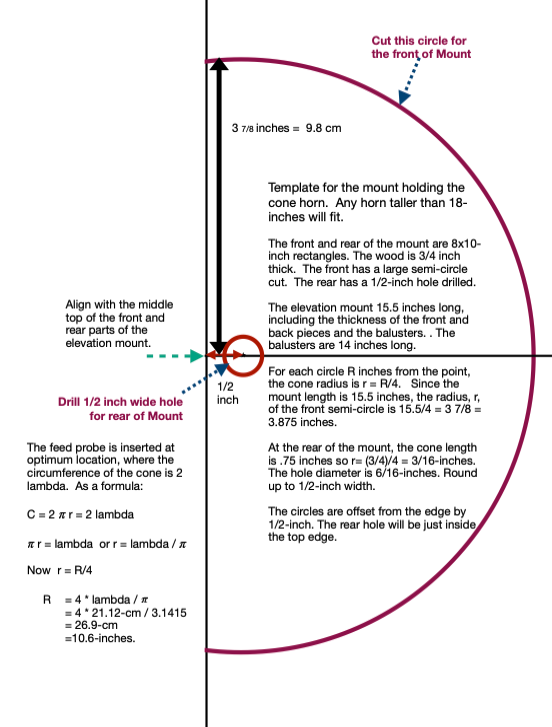
Elevation mount template (view PDF)
The cone-horn design uses a wooden elevation mount of four parts. Front and back are cut from a 10-inch wide, 8-inch tall board 0.75 inches thick; the sides are two 14-inch balusters.
About the memo series and contributions
LightWork shares practical work on citizen radio astronomy. Its name reflects radio light and collaboration: many hands make LightWork.
The archive contains 31 published memos, numbered through 37.