
Research examples
Radio transient simulation notebooks and data
Explore pulsar simulations, reference samples, and transient-detection designs.
These exploratory examples support advanced work on pulsars and radio transients.
Andrew Dyck developed them in 2019, with project setup and documentation by Pranav Sanghavi.
They live in radio-research-software, alongside the research applications.
Read a notebook
Read each notebook directly on DSPIRA. Each page includes a download for opening the example in Jupyter.
- Pulsar simulation
- Alternative background comparison
- Earlier peak-search development
- Bench data comparison
The notebook catalog also includes the classroom examples.
Use Python 3, Jupyter, NumPy, SciPy, and Matplotlib. Generated outputs use a local folder. The three pulsar notebooks have no saved outputs. The bench comparison retains its original results but requires unavailable recordings. Full simulations can require substantial memory. Their algorithms and scientific results have not been validated by this move.
Reference datasets
These original binary files have no headers. Their original parameter labels were not independently verified. Download names now identify each processing stage. Read the format and provenance notes before interpreting them.
- Pulse samples (download BIN)
- Signal-to-noise output (download BIN)
- Correlation output (download BIN)
- Dispersion trials (download BIN)
- Integrated spectra (download BIN)
- Noise samples (download BIN)
Design references
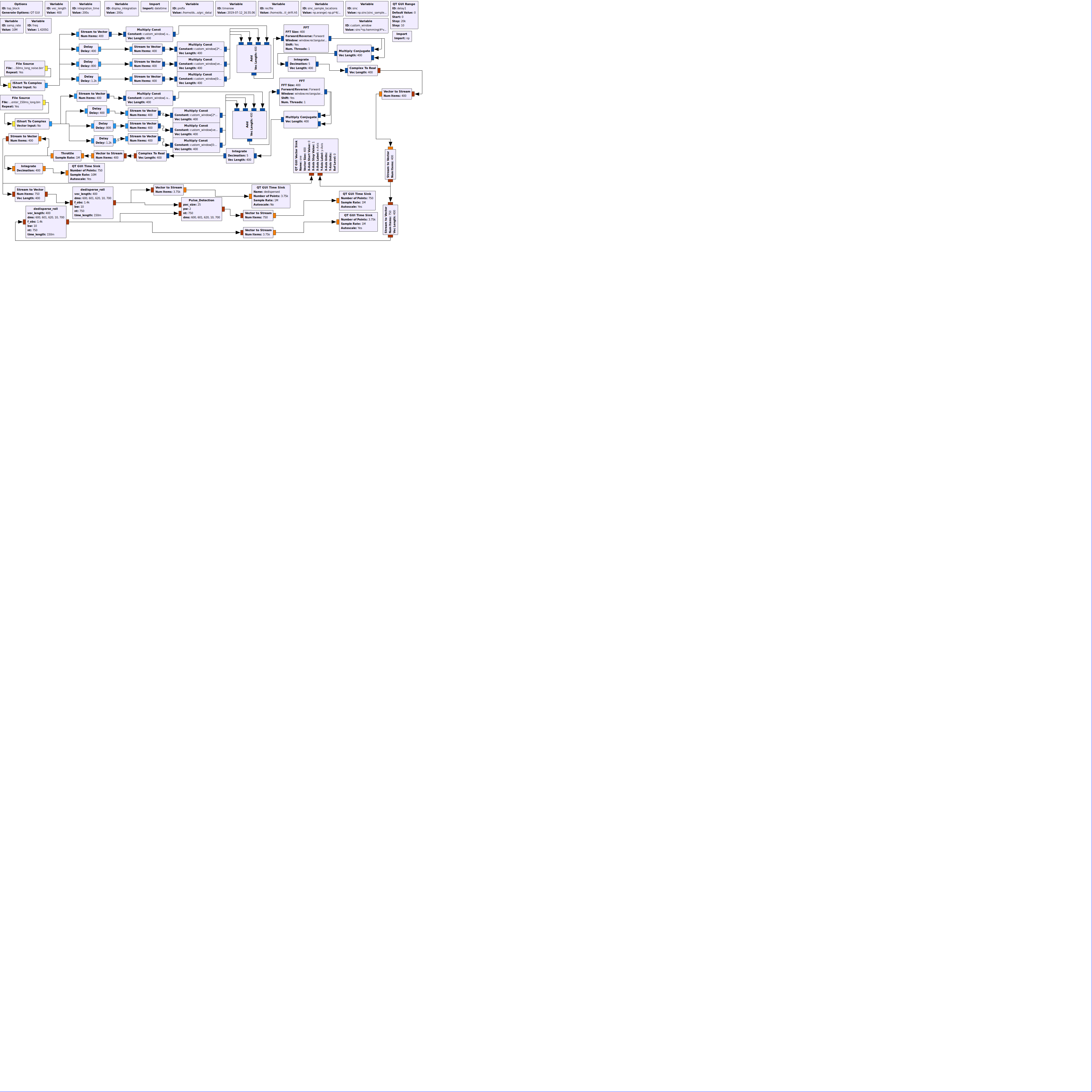
The flowgraph references retired GNU Radio 3.7 blocks and needs porting before use. For classroom telescope work, start with the DSPIRA software guide.