
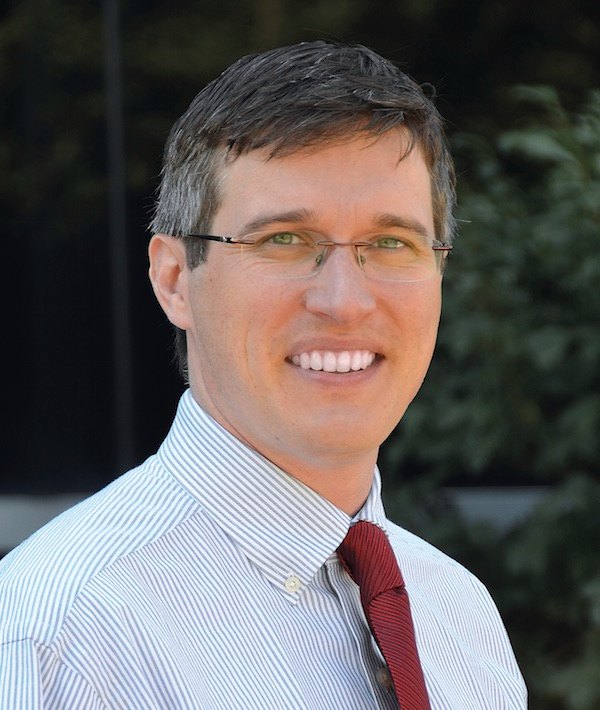
Kevin M. Bandura, Ph.D.
Associate Professor in WVU's Lane Department of Computer Science and Electrical Engineering. Adjunct Professor of Physics and Astronomy at WVU. Member of the WVU Center for Gravitational Waves and Cosmology. Builds instruments for CHIME, its FRB outriggers, and HIRAX. These surveys probe dark energy through 21 cm intensity mapping and detect fast radio bursts.
- kmbandura@mail.wvu.edu
- (304) 293-9686
- AERB 237, 109 Research Way, Morgantown, WV 26506
- ORCID
- Google Scholar
Education
-
Ph.D., Physics
Carnegie Mellon University
Pathfinder for a Neutral Hydrogen Dark Energy Survey (advisor: Jeff Peterson)
2011
-
B.S., Physics and Psychology
Carnegie Mellon University
2003
Appointments
-
Associate Professor
Lane Department of Computer Science and Electrical Engineering, West Virginia University
2021–present
-
Adjunct Professor
Department of Physics and Astronomy, West Virginia University
2015–present
-
Member
Center for Gravitational Waves and Cosmology, West Virginia University
-
Assistant Professor
Lane Department of Computer Science and Electrical Engineering, West Virginia University
2015–2021
-
Postdoctoral Fellow
Department of Physics, McGill University
2011–2015
Honors and awards
-
2026
Outstanding Researcher, senior level (2025–26)
Statler College of Engineering and Mineral Resources, West Virginia University
-
2023
Outstanding Researcher, senior level (2022–23)
Statler College of Engineering and Mineral Resources, West Virginia University
-
2022
Lancelot M. Berkeley – New York Community Trust Prize for Meritorious Work in Astronomy, awarded to the CHIME/FRB team
Funding
Amounts are NSF obligated totals to date. Each award links to its page in the NSF award search.
-
Mapping the Universe in Neutral Hydrogen with CHIME
NSF 2510773 · PI
2025–2028
$281,080
-
2025–2028
$321,340
-
Collaborative Research: New Interference Detection, Mitigation, and Fusion Methodologies
NSF 2307581 · Co-PI (PI N. Schmid, with D. Lorimer)
2023–2027
$510,811
-
2021–2026
$233,044
-
MRI: Development of a CHIME Outrigger Telescope
NSF 2018490 · PI (co-PIs J. Peterson, K. Masui)
2020–2026
$1,762,469
-
Collaborative Research: Cosmology with CHIME
NSF 2006548 · PI
2020–2024
$242,120
-
RET Site: Digital Signal Processing in Radio Astronomy (DSPIRA)
NSF 1611114 · Co-PI (PI N. Schmid)
2017–2021
$577,815
Publications
75 papers with CHIME, its FRB outriggers, and HIRAX, plus earlier work from the Carnegie Mellon and McGill years. The WVU-era entries also appear on the lab publication list.
Journal articles (50)
-
2026
Selected work
Millisecond-cadence Radio Frequency Interference Filters
J. W. Kania, K. Bandura, D. R. Lorimer, R. Prestage
Lab authors: K. Bandura J. Kania
The Astronomical Journal · AJ 171, 73 · 2026
-
2026
The Second CHIME/FRB Catalog of Fast Radio Bursts
CHIME/FRB Collaboration, incl. K. Bandura
Lab authors: K. Bandura
The Astrophysical Journal Supplement Series · ApJS 283, 34 · 2026
-
2025
A Catalog of Local Universe Fast Radio Bursts from CHIME/FRB and the KKO Outrigger
CHIME/FRB Collaboration, incl. K. Bandura
Lab authors: K. Bandura K. Khairy
The Astrophysical Journal Supplement Series · ApJS 280, 6 · 2025
-
2025
A pulsar-like polarization angle swing from a nearby fast radio burst
CHIME/FRB Collaboration, incl. K. Bandura
Lab authors: K. Bandura
Nature · 637, 43 · 2025
-
2025
A Very Long Baseline Interferometry Calibrator Grid at 600 MHz for Fast Radio Transient Localizations with CHIME/FRB Outriggers
CHIME/FRB Collaboration, incl. K. Bandura
Lab authors: K. Bandura
The Astrophysical Journal · ApJ 981, 39 · 2025
-
2025
Beam Maps of the Canadian Hydrogen Intensity Mapping Experiment (CHIME) Measured With a Drone
W. Tyndall et al., incl. K. Bandura
Lab authors: K. Bandura
IEEE Open Journal of Antennas and Propagation · IEEE OJAP 6, 928 · 2025
-
2025
CHIME/FRB Outriggers: Design Overview
CHIME/FRB Collaboration, incl. K. Bandura
Lab authors: K. Bandura K. Bhopi K. Khairy
The Astrophysical Journal · ApJ 993, 55 · 2025
-
2025
Demonstration of hybrid foreground removal on CHIME data
CHIME Collaboration, incl. K. Bandura
Lab authors: K. Bandura
Physical Review D · PRD 111, 103531 · 2025
-
2025
FRB 20250316A: A Brilliant and Nearby One-off Fast Radio Burst Localized to 13 pc Precision
CHIME/FRB Collaboration, incl. K. Bandura
Lab authors: K. Bandura K. Bhopi
The Astrophysical Journal Letters · ApJL 989, L48 · 2025
-
2025
Stellar Mass-Dispersion Measure Correlations Constrain Baryonic Feedback in Fast Radio Burst Host Galaxies
CHIME/FRB Collaboration, incl. K. Bandura
Lab authors: K. Bandura
The Astrophysical Journal Letters · ApJL 991, L25 · 2025
-
2024
A Detection of Cosmological 21 cm Emission from CHIME in Cross-correlation with eBOSS Measurements of the Lya Forest
CHIME Collaboration, incl. K. Bandura
Lab authors: K. Bandura
The Astrophysical Journal · ApJ 963, 23 · 2024
-
2024
Selected work
A fast radio burst localized at detection to an edge-on galaxy using very-long-baseline interferometry
T. Cassanelli, C. Leung, P. Sanghavi, et al., incl. K. Bandura
Lab authors: K. Bandura P. Sanghavi K. Khairy
Nature Astronomy · Nat. Astron. 8, 1429 · 2024
T. Cassanelli, C. Leung, and P. Sanghavi contributed equally — co-first and co-corresponding authors.
-
2024
CHIME/FRB Outriggers: KKO Station System and Commissioning Results
A. E. Lanman et al. (CHIME/FRB Collaboration), incl. K. Bandura
Lab authors: K. Bandura K. Khairy
The Astronomical Journal · AJ 168, 87 · 2024
-
2024
Do All Fast Radio Bursts Repeat? Constraints from CHIME/FRB Far Sidelobe FRBs
CHIME/FRB Collaboration, incl. K. Bandura
Lab authors: K. Bandura K. Khairy
The Astrophysical Journal · ApJ 975, 75 · 2024
-
2024
Interference detection in radio astronomy: applying Shapiro-Wilks normality test, spectral entropy, and spectral relative entropy
Z. Cao, N. A. Schmid, K. Bandura, D. R. Lorimer, et al.
Lab authors: K. Bandura
RAS Techniques and Instruments · RASTI 3, 535 · 2024
-
2024
Selected work
TONE: A CHIME/FRB Outrigger Pathfinder for Localizations of Fast Radio Bursts using Very Long Baseline Interferometry
P. Sanghavi, C. Leung, K. Bandura, et al.
Lab authors: K. Bandura P. Sanghavi K. Khairy
Journal of Astronomical Instrumentation · JAI 13, 2450010 · 2024
-
2024
Updating the First CHIME/FRB Catalog of Fast Radio Bursts with Baseband Data
CHIME/FRB Collaboration, incl. K. Bandura
Lab authors: K. Bandura
The Astrophysical Journal · ApJ 969, 145 · 2024
-
2023
Selected work
A Digital Calibration Source for 21 cm Cosmology Telescopes
K. Bhopi, W. Tyndall, P. Sanghavi, K. Bandura, L. Newburgh, J. Gallicchio
Lab authors: K. Bandura P. Sanghavi K. Bhopi
Journal of Astronomical Instrumentation · JAI 12, 2250016 · 2023
-
2023
CHIME/FRB Discovery of 25 Repeating Fast Radio Burst Sources
CHIME/FRB Collaboration, incl. K. Bandura
Lab authors: K. Bandura
The Astrophysical Journal · ApJ 947, 83 · 2023
-
2023
Detection of Cosmological 21 cm Emission with the Canadian Hydrogen Intensity Mapping Experiment
CHIME Collaboration, incl. K. Bandura
Lab authors: K. Bandura J. Kania
The Astrophysical Journal · ApJ 947, 16 · 2023
-
2022
A Clock Stabilization System for CHIME/FRB Outriggers
J. Mena-Parra et al. (CHIME/FRB Collaboration), incl. K. Bandura
Lab authors: K. Bandura
The Astronomical Journal · AJ 163, 48 · 2022
-
2022
A Sudden Period of High Activity from Repeating Fast Radio Burst 20201124A
A. E. Lanman, B. C. Andersen, P. Chawla, et al., incl. K. Bandura
Lab authors: K. Bandura P. Sanghavi
The Astrophysical Journal · ApJ 927, 59 · 2022
-
2022
An Overview of CHIME, the Canadian Hydrogen Intensity Mapping Experiment
CHIME Collaboration, incl. K. Bandura
Lab authors: K. Bandura J. Kania
The Astrophysical Journal Supplement Series · ApJS 261, 29 · 2022
-
2022
Constraining primordial black holes using fast radio burst gravitational-lens interferometry with CHIME/FRB
C. Leung, Z. Kader, K. W. Masui, et al., incl. K. Bandura
Lab authors: K. Bandura P. Sanghavi
Physical Review D · PRD 106, 043017 · 2022
-
2022
High-time resolution search for compact objects using fast radio burst gravitational lens interferometry with CHIME/FRB
Z. Kader, C. Leung, M. Dobbs, et al., incl. K. Bandura
Lab authors: K. Bandura P. Sanghavi
Physical Review D · PRD 106, 043016 · 2022
-
2022
Hydrogen Intensity and Real-Time Analysis Experiment: 256-element array status and overview
D. Crichton et al., incl. K. Bandura
Lab authors: K. Bandura P. Sanghavi J. Kania
Journal of Astronomical Telescopes, Instruments, and Systems · JATIS 8, 011019 · 2022
-
2022
Localizing FRBs through VLBI with the Algonquin Radio Observatory 10 m Telescope
T. Cassanelli, C. Leung, M. Rahman, et al., incl. K. Bandura
Lab authors: K. Bandura P. Sanghavi
The Astronomical Journal · AJ 163, 65 · 2022
-
2022
Modeling Fast Radio Burst Dispersion and Scattering Properties in the First CHIME/FRB Catalog
P. Chawla, V. M. Kaspi, S. M. Ransom, et al.
Lab authors: K. Bandura P. Sanghavi
The Astrophysical Journal · ApJ 927, 35 · 2022
-
2022
Using the Sun to Measure the Primary Beam Response of the Canadian Hydrogen Intensity Mapping Experiment
CHIME Collaboration, incl. K. Bandura
Lab authors: K. Bandura J. Kania
The Astrophysical Journal · ApJ 932, 100 · 2022
-
2021
A Local Universe Host for the Repeating Fast Radio Burst FRB 20181030A
M. Bhardwaj, A. Yu. Kirichenko, D. Michilli, et al.
Lab authors: K. Bandura P. Sanghavi
The Astrophysical Journal Letters · ApJL 919, L24 · 2021
-
2021
A Synoptic VLBI Technique for Localizing Nonrepeating Fast Radio Bursts with CHIME/FRB
C. Leung, J. Mena-Parra, K. Masui, et al.
Lab authors: K. Bandura P. Sanghavi
The Astronomical Journal · AJ 161, 81 · 2021
-
2021
An Analysis Pipeline for CHIME/FRB Full-array Baseband Data
CHIME/FRB Collaboration, incl. K. Bandura
Lab authors: K. Bandura
The Astrophysical Journal · ApJ 910, 147 · 2021
-
2021
CHIME/FRB Catalog 1 Results: Statistical Cross-correlations with Large-scale Structure
M. Rafiei-Ravandi, K. M. Smith, D. Li, et al., incl. K. Bandura
Lab authors: K. Bandura P. Sanghavi
The Astrophysical Journal · ApJ 922, 42 · 2021
-
2021
Fast Radio Burst Morphology in the First CHIME/FRB Catalog
Z. Pleunis, D. C. Good, V. M. Kaspi, et al., incl. K. Bandura
Lab authors: K. Bandura P. Sanghavi
The Astrophysical Journal · ApJ 923, 1 · 2021
-
2021
No Evidence for Galactic Latitude Dependence of the Fast Radio Burst Sky Distribution
A. Josephy, P. Chawla, A. P. Curtin, et al.
Lab authors: K. Bandura P. Sanghavi
The Astrophysical Journal · ApJ 923, 2 · 2021
-
2021
The CHIME Pulsar Project: System Overview
CHIME/Pulsar Collaboration, incl. K. Bandura
Lab authors: K. Bandura
The Astrophysical Journal Supplement Series · ApJS 255, 5 · 2021
-
2021
The First CHIME/FRB Fast Radio Burst Catalog
CHIME/FRB Collaboration, incl. K. Bandura
Lab authors: K. Bandura P. Sanghavi J. Kania
The Astrophysical Journal Supplement Series · ApJS 257, 59 · 2021
-
2020
A bright millisecond-duration radio burst from a Galactic magnetar
CHIME/FRB Collaboration, incl. K. Bandura
Lab authors: K. Bandura P. Sanghavi J. Kania
Nature · 587, 54 · 2020
-
2020
A repeating fast radio burst source localized to a nearby spiral galaxy
CHIME/FRB Collaboration, incl. K. Bandura
Lab authors: K. Bandura
Nature · 577, 190 · 2020
-
2020
Detection of Repeating FRB 180916.J0158+65 Down to Frequencies of 300 MHz
P. Chawla, B. C. Andersen, M. Bhardwaj, et al., incl. K. Bandura
Lab authors: K. Bandura P. Sanghavi
The Astrophysical Journal Letters · ApJL 896, L41 · 2020
-
2020
Nine New Repeating Fast Radio Burst Sources from CHIME/FRB
CHIME/FRB Collaboration, incl. K. Bandura
Lab authors: K. Bandura
The Astrophysical Journal Letters · ApJL 891, L6 · 2020
-
2020
Periodic activity from a fast radio burst source
CHIME/FRB Collaboration, incl. K. Bandura
Lab authors: K. Bandura P. Sanghavi J. Kania
Nature · 582, 351 · 2020
-
2020
Simultaneous X-Ray and Radio Observations of the Repeating Fast Radio Burst FRB 180916.J0158+65
P. Scholz et al. (CHIME/FRB Collaboration), incl. K. Bandura
Lab authors: K. Bandura
The Astrophysical Journal · ApJ 901, 165 · 2020
-
2019
Nature cover Cover story, Nature, 14 February 2019 — "Space and CHIME"
Observations of fast radio bursts at frequencies down to 400 megahertz
CHIME/FRB Collaboration, incl. K. Bandura
Lab authors: K. Bandura
Nature · 566, 230 · 2019
-
2019
CHIME/FRB Detection of the Original Repeating Fast Radio Burst Source FRB 121102
CHIME/FRB Collaboration, incl. K. Bandura
Lab authors: K. Bandura
The Astrophysical Journal Letters · ApJL 882, L18 · 2019
-
2019
CHIME/FRB Discovery of Eight New Repeating Fast Radio Burst Sources
CHIME/FRB Collaboration, incl. K. Bandura
Lab authors: K. Bandura
The Astrophysical Journal Letters · ApJL 885, L24 · 2019
-
2019
Nature cover Cover story, Nature, 14 February 2019 — "Space and CHIME"
A Second Source of Repeating Fast Radio Bursts
CHIME/FRB Collaboration, incl. K. Bandura
Lab authors: K. Bandura
Nature · 566, 235 · 2019
-
2018
Quantization Bias for Digital Correlators
J. Mena-Parra, K. Bandura, M. A. Dobbs, et al.
Lab authors: K. Bandura
Journal of Astronomical Instrumentation · JAI 7, 1850008 · 2018
-
2018
The CHIME Fast Radio Burst Project: System Overview
CHIME/FRB Collaboration, incl. K. Bandura
Lab authors: K. Bandura
The Astrophysical Journal · ApJ 863, 48 · 2018
-
2017
Limits on the ultra-bright Fast Radio Burst population from the CHIME Pathfinder
CHIME Scientific Collaboration, incl. K. Bandura
Lab authors: K. Bandura
The Astrophysical Journal · ApJ 844, 161 · 2017
Conference proceedings (8)
-
2022
Antenna characterization for the HIRAX experiment
E. R. Kuhn et al., incl. K. Bandura
Lab authors: K. Bandura
Proc. SPIE 12182, Ground-based and Airborne Telescopes IX · Proc. SPIE 12182, 1218225 · 2022
-
2022
Characterization of the John A. Galt telescope for radio holography with CHIME
A. Reda, T. Pinsonneault-Marotte, M. Deng, et al., incl. K. Bandura
Lab authors: K. Bandura J. Kania
Proc. SPIE 12190, Millimeter, Submillimeter, and Far-Infrared Detectors and Instrumentation for Astronomy XI · Proc. SPIE 12190, 121902V · 2022
-
2020
Mechanical and optical design of the HIRAX radio telescope
B. R. B. Saliwanchik et al., incl. K. Bandura
Lab authors: K. Bandura
Proc. SPIE 11445, Ground-based and Airborne Telescopes VIII · Proc. SPIE 11445, 114455O · 2020
-
2020
Noise temperature testing for the Hydrogen Intensity and Real-time Analysis eXperiment (HIRAX)
E. R. Kuhn et al., incl. K. Bandura
Lab authors: K. Bandura
Proc. SPIE 11445, Ground-based and Airborne Telescopes VIII · Proc. SPIE 11445, 114452Z · 2020
-
2019
Selected work
Digital Signal Processing in Radio Astronomy: An Interdisciplinary Experience
P. Sanghavi, K. Bandura, J. Makous, H. Chun
Lab authors: K. Bandura P. Sanghavi
2019 IEEE Integrated STEM Education Conference (ISEC) · pp. 362-366 · 2019
-
2017
CHIME FRB: An application of FFT beamforming for a radio telescope
C. Ng et al., incl. K. Bandura
Lab authors: K. Bandura
2017 XXXIInd URSI General Assembly and Scientific Symposium (GASS) · 2017
-
2016
HIRAX: a probe of dark energy and radio transients
L. B. Newburgh, K. Bandura, et al.
Lab authors: K. Bandura
Proc. SPIE 9906, Ground-based and Airborne Telescopes VI · Proc. SPIE 9906, 99065X · 2016
-
2016
Holographic beam mapping of the CHIME pathfinder array
P. Berger, L. B. Newburgh, et al., incl. K. Bandura
Lab authors: K. Bandura
Proc. SPIE 9906, Ground-based and Airborne Telescopes VI · Proc. SPIE 9906, 99060D · 2016
Research notes and preprints (2)
-
2026
Discovery of Microsecond Duration Radio Flashes with Small Radio Telescopes
G. Langston, K. Bandura, P. Sanghavi
Lab authors: K. Bandura P. Sanghavi
Research Notes of the AAS · RNAAS 10, 7 · 2026
-
2026
Selected work
PEACC - Precision Emitter for 21 cm Array Coherent Calibration Preprint
K. Bhopi, M. Cole, M. Helfenbein, W. Tyndall, A. Whitmer, K. Bandura, L. Newburgh
Lab authors: K. Bandura K. Bhopi
arXiv preprint · 2026
Before WVU (15)
The Carnegie Mellon and McGill years, 2006–2016. Work included 21 cm intensity mapping at the GBT and GMRT, the CHIME Pathfinder, and ICE correlator hardware.
-
2016
ICE: A Scalable, Low-cost FPGA-Based Telescope Signal Processing and Networking System
K. Bandura, A. N. Bender, J. F. Cliche, T. de Haan, M. A. Dobbs, et al.
Journal of Astronomical Instrumentation · JAI 5 · 2016
-
2016
ICE-Based Custom Full-Mesh Network for the CHIME High Bandwidth Radio Astronomy Correlator
K. Bandura, J. F. Cliche, M. A. Dobbs, A. J. Gilbert, D. Ittah, J. Mena-Parra, G. Smecher
Journal of Astronomical Instrumentation · JAI 5 · 2016
-
2015
GPU Kernels for High-Speed 4-Bit Astrophysical Data Processing
P. Klages, K. Bandura, N. Denman, A. Recnik, J. Sievers, K. Vanderlinde
2015 IEEE 26th Int. Conf. on Application-specific Systems, Architectures and Processors (ASAP) · pp. 164–165 · 2015
-
2015
A GPU-based Correlator X-engine Implemented on the CHIME Pathfinder
N. Denman et al., incl. K. Bandura
2015 IEEE 26th Int. Conf. on Application-specific Systems, Architectures and Processors (ASAP) · pp. 35–40 · 2015
-
2015
An Efficient Real-time Data Pipeline for the CHIME Pathfinder Radio Telescope X-engine
A. Recnik et al., incl. K. Bandura
2015 IEEE 26th Int. Conf. on Application-specific Systems, Architectures and Processors (ASAP) · pp. 57–61 · 2015
-
2014
The Performance of the Bolometer Array and Readout System during the 2012/2013 Flight of the E and B Experiment (EBEX)
EBEX Collaboration, incl. K. Bandura
Proc. SPIE 9153, Millimeter, Submillimeter, and Far-Infrared Detectors and Instrumentation for Astronomy VII · 2014
-
2014
Canadian Hydrogen Intensity Mapping Experiment (CHIME) Pathfinder
K. Bandura et al.
Proc. SPIE 9145, Ground-based and Airborne Telescopes V · 914522 · 2014
-
2014
Calibrating CHIME: A New Radio Interferometer to Probe Dark Energy
L. B. Newburgh et al., incl. K. Bandura
Proc. SPIE 9145, Ground-based and Airborne Telescopes V · 2014
-
2013
A Radio-Frequency-over-Fiber Link for Large-Array Radio Astronomy Applications
J. Mena-Parra, K. Bandura, J.-F. Cliche, M. A. Dobbs, A. Gilbert, Q. Y. Tang
Journal of Instrumentation · JINST 8, T10003 · 2013
-
2013
A Simulation-calibrated Limit on the HI Power Spectrum from the GMRT Epoch of Reionization Experiment
G. Paciga, J. G. Albert, K. Bandura, et al.
Monthly Notices of the Royal Astronomical Society · MNRAS 433, 639 · 2013
-
2013
Determination of z ≈ 0.8 Neutral Hydrogen Fluctuations Using the 21 cm Intensity Mapping Autocorrelation
E. R. Switzer, K. W. Masui, K. Bandura, et al.
Monthly Notices of the Royal Astronomical Society: Letters · MNRAS 434, L46 · 2013
-
2013
Measurement of 21 cm Brightness Fluctuations at z ≈ 0.8 in Cross-correlation
K. W. Masui, E. R. Switzer, N. Banavar, K. Bandura, et al.
The Astrophysical Journal Letters · ApJL 763, L20 · 2013
-
2010
An Intensity Map of Hydrogen 21-cm Emission at Redshift z ≈ 0.8
T.-C. Chang, U.-L. Pen, K. Bandura, J. B. Peterson
Nature · 466, 463 · 2010
-
2008
The GMRT Search for Reionization: The Evolution of Galaxies Through the Neutral Hydrogen Window
U.-L. Pen, T.-C. Chang, J. B. Peterson, J. Roy, Y. Gupta, K. Bandura
AIP Conference Proceedings · AIP Conf. Proc. 1035, 75 · 2008
-
2006
The Hubble Sphere Hydrogen Survey Preprint
J. B. Peterson, K. Bandura, U.-L. Pen
arXiv preprint · 2006
Retracted (1)
One paper was retracted after publication; its entry carries the retraction notice.
-
2022
Sub-second periodicity in a fast radio burst
CHIME/FRB Collaboration, incl. K. Bandura
Lab authors: K. Bandura P. Sanghavi J. Kania
Nature · 607, 256 · 2022
Retracted 23 June 2026 (retraction notice: doi 10.1038/s41586-026-10799-8). A calibration problem misdirected CHIME's digital beams when FRB 20191221A was detected. The reported periodicity came from the known Galactic pulsar PSR J0248+6021.
White papers and reports
Decadal-survey and long-range-plan submissions on the PUMA concept, CHORD and the intensity-mapping program, going back to Astro2010.
-
2019
LRP 2020 Whitepaper: The Canadian Hydrogen Observatory and Radio-transient Detector (CHORD)
K. Vanderlinde, K. Bandura, L. Belostotski, R. Bond, P. Boyle, et al.
Canadian Long Range Plan (LRP2020) white paper · 2019
-
2019
Packed Ultra-wideband Mapping Array (PUMA): A Radio Telescope for Cosmology and Transients
K. Bandura, E. Castorina, L. Connor, et al.
Astro2020 Decadal Survey project white paper · 2019
-
2019
Research and Development for HI Intensity Mapping
P. Timbie et al., incl. K. Bandura
Astro2020 Decadal Survey APC white paper · 2019
-
2018
Inflation and Early Dark Energy with a Stage II Hydrogen Intensity Mapping Experiment
Cosmic Visions 21 cm Collaboration (R. Ansari, E. J. Arena, K. Bandura, et al.)
Cosmic Visions Dark Energy report · 2018
-
2009
21-cm Intensity Mapping
J. B. Peterson et al., incl. K. Bandura
Astro2010 Decadal Survey white paper · 2009
Teaching
-
EE 221 — Introduction to Electrical Engineering
West Virginia University
-
EE 345 — Engineering Electromagnetics
West Virginia University
-
EE 564 — Digital Signal Processing for Radio Astronomy
West Virginia University
Course syllabi: EE 221 (Fall 2018) · EE 591B, DSP for Radio Astronomy (Spring 2017).
Graduate students
Every graduate of the lab, with a link to their thesis or dissertation, all also on the people page.
Graduated (7)
-
Kalyani B. Bhopi
Ph.D. Dissertation · 2026
A Digital Calibration Source for 21 cm Cosmology Telescopes
Now: Postdoctoral Fellow, Academia Sinica (Taiwan)
-
John W. Metzger
M.S. Thesis · 2026
-
Kholoud S. T. A. Khairy
M.S. Thesis · 2025
Green Bank CHIME/FRB Outriggers Commissioning and Analog System Development
Now: System Engineer III, M.C. Dean
-
Joseph W. Kania
Ph.D. Dissertation · 2023
Applications of Digital Filters in Radio Astronomy
Now: Senior Research Platforms Engineer, University of Manchester
-
Pranav R. Sanghavi
Ph.D. Dissertation · 2022
Pathfinding Fast Radio Bursts Localizations using Very Long Baseline Interferometry
Now: Postdoctoral Fellow, Center for Astrophysics | Harvard and Smithsonian
-
Xiaoqian He
M.S. Thesis · 2018
Spatial Fourier Transform for Blind Detection of Radio Observations of Rotating Radio Transients
Now: Senior System Design Engineer, AMD
-
Akshaya Rane
Ph.D. Dissertation · 2017
A Study of the Fast Radio Burst Population
Now: Senior Data Scientist, lululemon
Committee service (5)
Graduate committees served on across Physics and Astronomy and the Lane Department, beyond his own students above.
-
Evan T. Smith
Ph.D., Physics and Astronomy · 2022
-
Morgan R. Dameron
M.S., Lane Dept. of CSEE · 2022
-
Brent J. Shapiro-Albert
Ph.D., Physics and Astronomy · 2021
Pulsar Noise Processes and Emission Physics
Chair: Maura McLaughlin
-
Marwan M. Alkhweldi
Ph.D., Lane Dept. of CSEE · 2021
Transform Based Approaches for the Detection of Astrophysical Signals
Chair: Natalia A. Schmid
-
Nickolas M. Pingel
Ph.D., Physics and Astronomy · 2017
Professional memberships
- IEEE
- American Physical Society
- American Astronomical Society
- American Society for Engineering Education
Selected talks and posters
- WVUniverse public talk, WVU Planetarium — backyard radio astronomy — 2026
- APS Mid-Atlantic Section Meeting (poster) — 2015
- SPIE Astronomical Telescopes + Instrumentation, Montreal — 2014
- URSI, Boulder, Colorado — 2014
- Interferometric Techniques for Impulsive Signals at Radio/Microwave Frequencies, Ohio State University — 2013
- Intensity Mapping Workshop, Oxford — 2012
- AAS Meeting, Boston (poster) — 2011
- Great Lakes Cosmology Workshop (poster) — 2009
- Sackler 21 cm Cosmology Conference, Harvard (poster) — 2008
Profiles and links
Academic profiles, university pages, and course listings.
In the media
University news and press coverage of the lab's instruments and results, 2017 to now.
-
2026
-
2026
WVUniverse public talk on backyard radio astronomy
WVU Physics and Astronomy and WVU Planetarium, on Instagram
-
2025
WVU engineers recalibrate radio telescopes to illuminate dark energy
WVU, via EurekAlert
-
2022
WVU researchers on team that detected strange cosmic 'heartbeat'
Statler College News — coverage of the paper since retracted (see Publications)
-
2021
Bandura to start a new National Science Foundation project
Statler College News
-
2020
New telescope in works at Green Bank to detect, map fast radio bursts
Charleston Gazette-Mail
-
2016
This page uses the same data as the lab's publication and people pages. It lists 60 WVU-era papers and 7 graduates. A print-ready CV is also available.